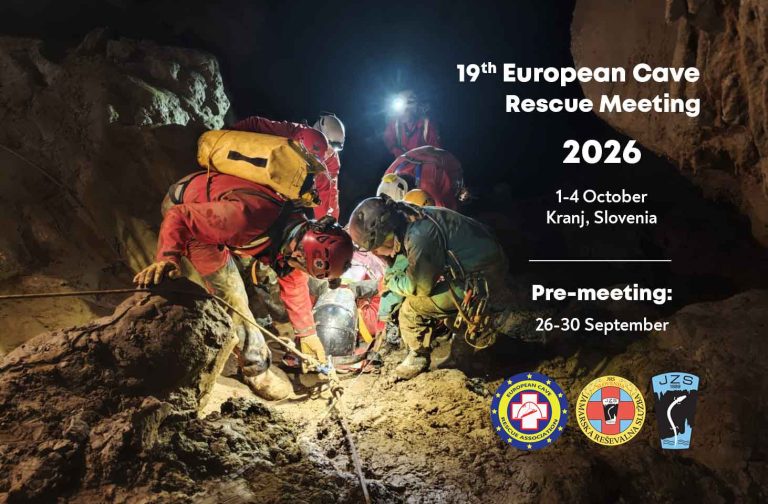
Updated information about 9th European Cave Rescue Meeting.
9th European Cave Rescue Meeting 2015 is going to take place in Mescek haza, Orfű, Hungary between 2nd – 4th October 2015.
Organized by Magyar Barlangi Mentőszolgálat (Hungarian Cave Rescue Service)
on a behalf of European Cave Rescue Association
To help you to find Mecsek Haza its coordinates are as follows:
N 46° 8′ 56.39″
E 18° 8′ 38.27″
PROGRAM
Program can be downloaded here in pdf format: ECRA Program.
Bivouac for injured person and Hostels for rescuers Session, Synopsis
This document outlines how the bivouac for injured person or „hot spot” and hostels for rescuers session will be organised.
In lecture room:
Part 1: Why do we need bivouac for injured person and what types of bivouacs we use
(CMRS)
Several types of bivouacs (4) that is used in cave rescue, including the results of test how much is needed to heat each bivouac, which temperature can be achieved, how much is needed to set bivouac.
Estimated 30 minutes.
Part 2: Protocol for bivouac team and bivouac kit
(CMRS)
It will be exposed SOP for cave rescue operation to highlight position of the first team for assessment and support. SOP for team and bivouac kit
Estimated 60 minutes.
Part 3: Why and when do we need hostels
(SSS, CNSAS, CMRS, BW, OHR)
Underground bivouacs and camps (hotels..), what’ the status, what is most suitable for rescuers.
Estimated 30 minutes.
Part 4: Hostels for rescuers in a kit – equipment and guidelines
(CNSAS)
A comprehensive and flexible “hostel kit” model is proposed together with the basic criteria for equipment choice, transportation and supply.
Estimated 30 minutes.
Part 5: Digital data transmission over telephone un-shielded twisted pair
(CNSAS)
A transmission system to communicate “digital”: do we need it?
Solutions and perspectives.
Estimated 30 minutes.
In Cave:
Part 6: Camp kit
(CNSAS)
Demonstration and installation of a camp kit model.
Estimated 45 minutes.
Part 7: Communication between surface and „hot spot”
(CNSAS)
Digital data transmission over telephone un-shielded twisted pair.
Estimated 60 minutes.
Part 8: Each country, each team will briefly present bivouacs and protocol for bivouac team that is used
(all)
In presentation room or in cave each team will be able to demonstrate their own protocols for the team for assessment and support. At the end we can issue document with all available data.
Estimated 60 minutes.
Foul Air Session, Synopsis
This document outlines how the Foul Air session will be organised. This first draft is subject to review if further proposals are received.
Part 1: Why do we need to worry about Foul or Bar Air
This shortish session will visit a number of incidents where Foul Air has been encountered and the outcome of these. Will include the rescue at Monterolier, France where rescuers died.
Will visit different examples of where bad air has been encountered and the outcomes. Most in the presentation will be from Britain, but audience will be invited to comment and add as they see fit.
Estimated 15 to 20 minutes.
Part 2: Technical Presentation on the Foul Air that we may find
This is really a chemisty lecture! Starts with most common – lack of oxygen and increased carbon dioxide (which ofter go together).
Will then cover carbon monoxide and nitrogen fumes for example from use of explosives.
Estimated 30 to 40 minutes.
Part 3: Detection of Foul Air
Awareness of Foul Air situations.
What methods do we have to detect Foul Air situations.
Part 4: Mitigation of Foul Air Situations
So we are aware there may be Foul Air in a situation. What can we as cave rescuers do to resolve the problem.
As mentioned early, awareness is prime so that we do not put our team members in danger.
Then, does the team have a Foul Air capabilty – have we trained in such situations and do we have equipment for the situation. If not, the call on the services of those we do.
We will then look at detection of Foul Air – Draeger manual systems and more sophisticated electonic systems. Any others – will invite audience to contribute.
Finally will look at work of a group in the UK who (some time back) developed a cheap solution to clear areas of bad air.
Estimated 20 to 30 minutes.